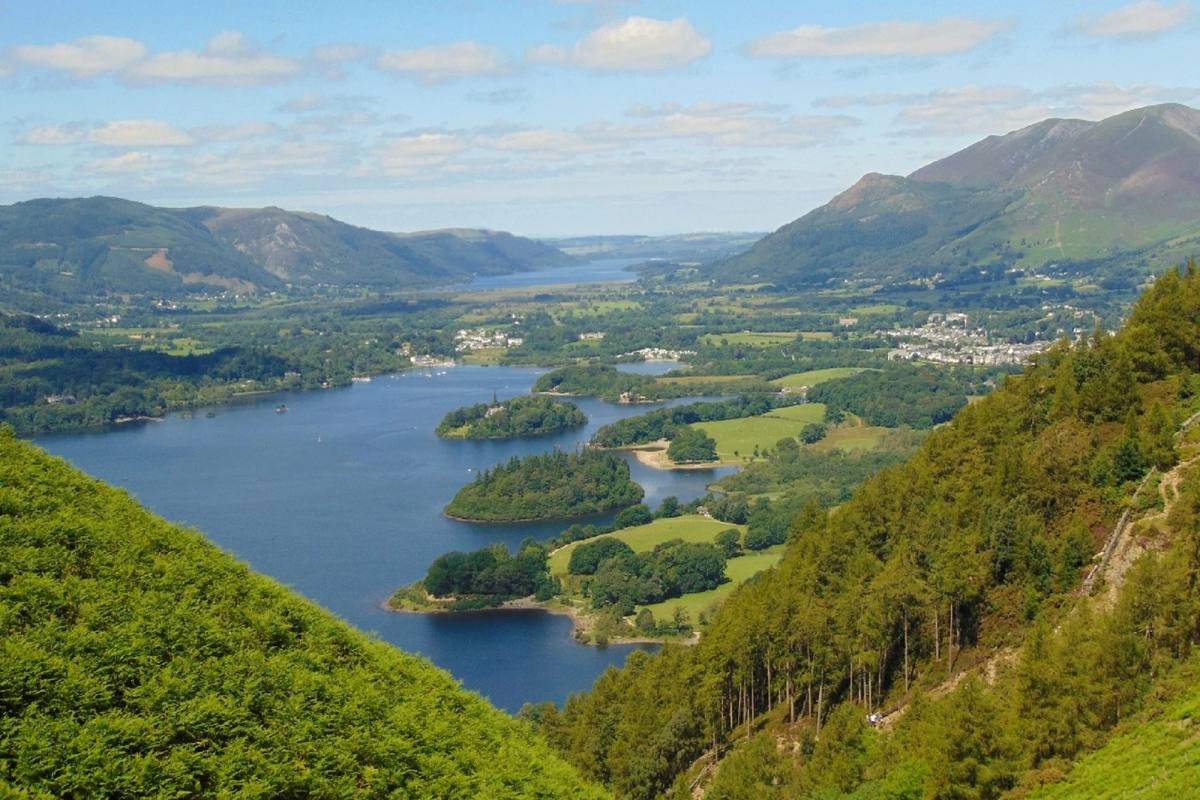

Walk around the town
The character of the buildings in Keswick and the landscapes around the town reflects not only the human history of the past few thousand years but a geological history extending over nearly five hundred million.
As you walk around the town you are surrounded by volcanic rocks. The green Lakeland slates are volcanic ashes that fell from eruption clouds into lakes about 450 million years ago. The red-brown pavement slabs in the Market Square and some surrounding streets were imported from northern Italy; they too have a volcanic origin, deposited from hot — around 1000°C — dense, ground-hugging clouds of volcanic debris.
The red sandstones seen in many windowsills, door jambs and lintels were deposited in desert sand dunes 280 million years ago, when Britain sat at the same latitude as the Sahara does today.
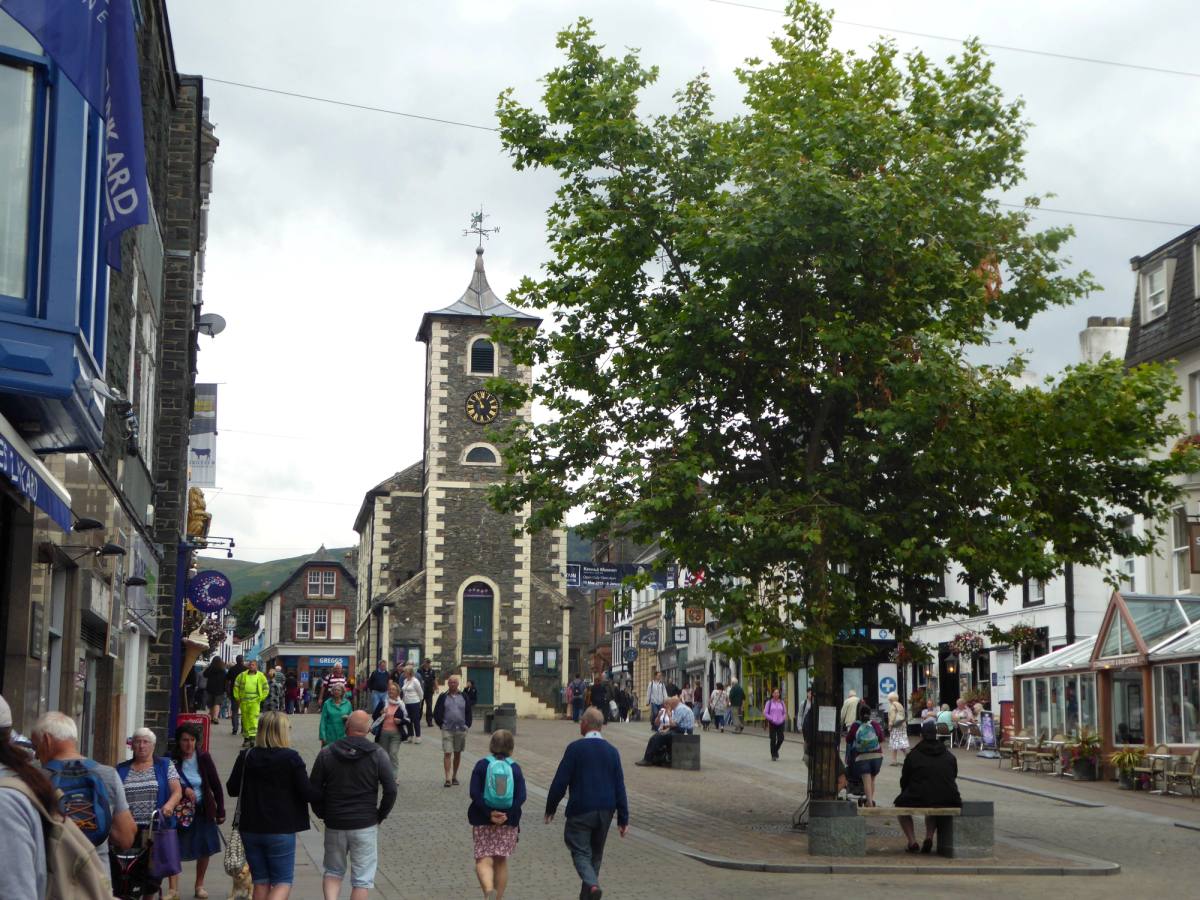
Market Square and the Moot Hall
Building stones and some paved areas in Keswick tell volcanic stories. The characteristic Lakeland green slate walls and roofs are 450-million-year-old volcanic ashes from Borrowdale.
The red-brown setts and paving slabs in the Market Square are volcanic rocks imported from northern Italy, deposited from extremely hot, dense, ground-hugging clouds formed by violent eruptions.
Then look at the skyline
Walk up Latrigg or Walla Crag for views that reveal more. The contrasting shapes of the fells north and west of Keswick and those to the south reflect the different rocks beneath them.
The smooth slopes to the north and west are underlain by Skiddaw Group rocks, laid down on a deep-sea floor as muds and fine-grained sands between 480 and 460 million years ago. Later they were altered to slates and sandstones — buried beneath younger units, then caught up in a mountain-building episode that culminated about 400 million years ago, when the Lake District was part of a chain comparable in scale to the Alps.
The harder, erosion-resistant volcanic rocks of the Borrowdale Volcanic Group underlie the more rugged Central Fells to the south. That volcanic episode ran between 460 and 450 million years ago and includes some of the largest eruptions known to science anywhere in the world.
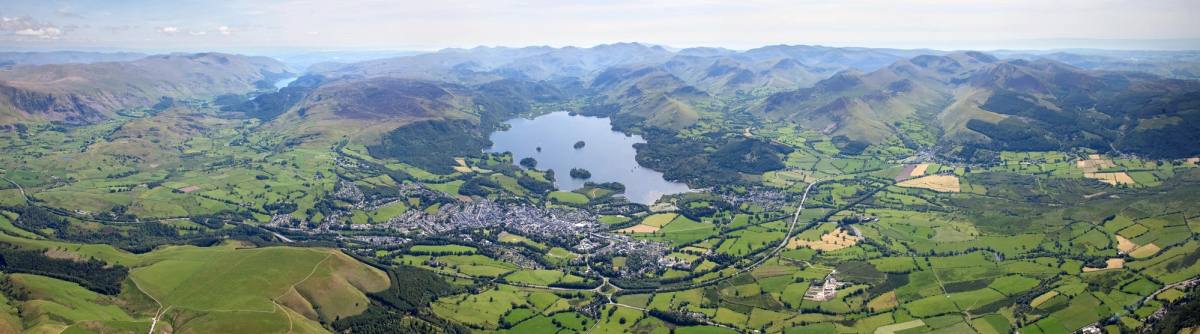
Looking south from Latrigg
Twenty thousand years ago this view would have looked very different. Glaciers occupied all the valleys between the fells, flowing up Borrowdale and Derwentwater towards Keswick. The low elongate hills the town is built on were sculpted at the base of fast-flowing ice.
And 450 million years ago the area experienced volcanic mayhem — lava flows and violent explosions, throwing up clouds tens of kilometres high.
The ice that arranged it
Twenty thousand years ago large glaciers flowed along Borrowdale towards Keswick, east and north-east along the Newlands valley, and east along the Greta. They merged and flowed north-west across what is now Bassenthwaite Lake. The town is built on a series of low, rounded, elongate hills of glacial debris sculpted beneath that fast-flowing ice.
Who wrote this
This page was written for us by the Skiddaw U3A Geology Group, with thanks. If it has left you wanting to know which rock you are standing on, they are the people to ask.